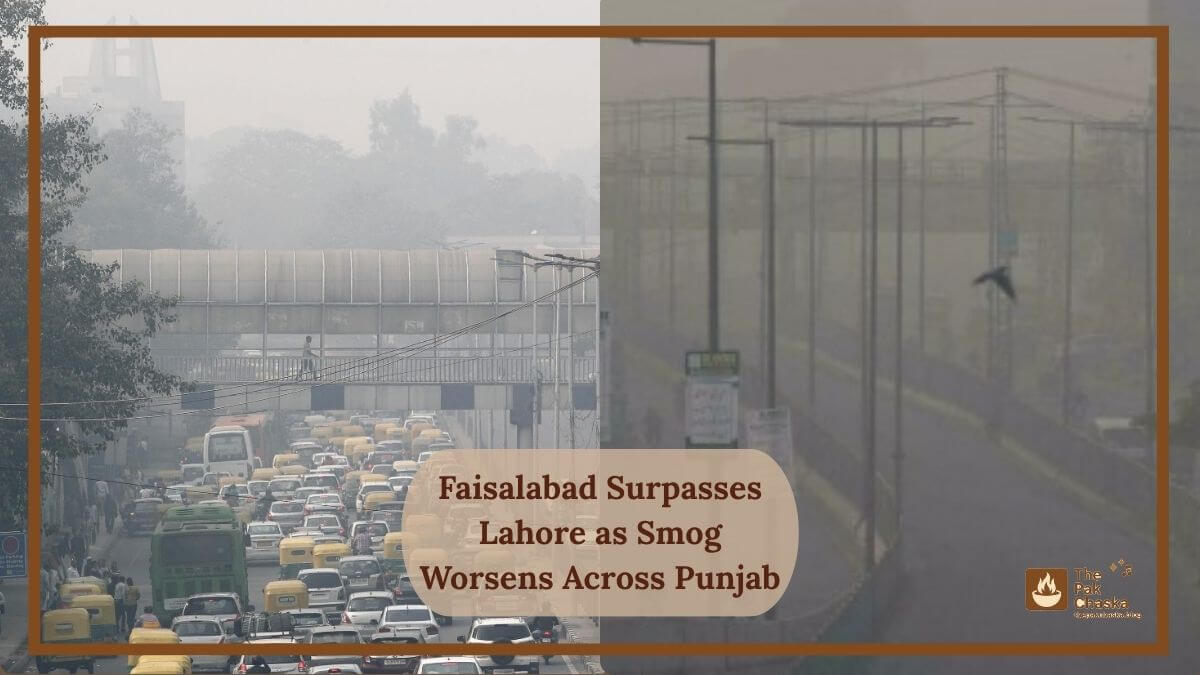
The most polluted city in Pakistan is now Faisalabad, not Lahore, according to new statistics on air quality. As smog gets thicker in Punjab, the air quality has dropped to dangerously low levels, which has led to health warnings and new arguments about pollution across borders, industry emissions, and the government’s lack of action.
The Rise of Faisalabad’s Air Pollution Crisis:
Lahore was called the “smog capital” of Pakistan for many years. This season, however, Faisalabad’s pollution levels have risen dramatically, making it worse than Lahore in terms of both particulate matter and total Air Quality Index (AQI). This change is because of worsening weather that keeps pollutants closer to the ground, more pollution from factories, and the burning of crop waste.
This week, there were days when Faisalabad’s AQI went over 400, which is a number that international health standards call “hazardous.” Residents said they had trouble breathing, their eyes hurt, and they had constant throat infections. As the air quality keeps getting worse, schools, hospitals, and businesses are having a hard time keeping up.
Winds from India Worsening the Situation:
Meteorological sources say that winds from the eastern parts of India are carrying dirty air across to Punjab, making the smog even worse there. The winds, which usually blow west during this time of year, carry a thick mix of smoke from northern India farm fires and emissions from factories.
Officials from both countries have long said that the other is to blame for the worsening smog, but activists say the problem goes beyond borders. An environmental scientist from Lahore said, “Air pollution doesn’t know any borders.” “This is a problem in the region that needs cooperation, not pointing fingers.”
Check Also: MDCAT Papers Moved in Iron Boxes Under Tight Security
Health Experts Sound the Alarm:
In Punjab, doctors are seeing a sharp rise in lung illnesses, mostly in kids and older people. There have been a lot more asthma, bronchitis, and eye diseases in just the last two weeks. People are being told by hospitals to limit their time outside and wear masks when they do go outside.
A pulmonologist in Faisalabad named Dr. Shazia Malik said, “Even healthy people are being affected.” “The bad air quality is making a huge number of patients come in with headaches, tiredness, and shortness of breath.”
The Punjab Health Department has asked schools to think about closing for a short time on days when the AQI is above 300. This is especially important in Faisalabad, Lahore, and Gujranwala, which have the worst pollution levels right now.
Government Response and Public Frustration:
As pressure on the Punjab government has grown, it has taken some limited steps to control emissions. These include limiting industry activity during peak smog hours and fining people who burn crops. People and environmentalists, on the other hand, say that the steps are too little, too late.
A person who lives in Faisalabad said, “Every year we hear promises and short-term bans, but no long-term solutions.” “We need strict rules, not just announcements.”
Several NGOs have also said that the lack of urban planning and public transportation options forces millions of people to depend on older, smoke-belching cars, which is one of the main causes of pollution in cities.
A Regional Problem Demanding Regional Solutions:
Experts say that India and Pakistan need to work together to get rid of smog in the area. The haze that covers both countries every winter could be lessened by sharing environmental data, keeping an eye on things together, and putting tighter limits on emissions.
As long as people don’t work together, places like Faisalabad and Lahore will have to deal with dirty air, higher health risks, and a lower quality of life.
What’s Next for Faisalabad and Punjab?
Environmental groups say that things could get worse in the next few weeks as temperatures drop and winds slow down, keeping pollutants close to the surface. If nothing is done right away, Faisalabad’s pollution problem could get worse, putting millions of people in danger.
At the moment, health experts say that people should stay inside during times of high smog, use air filters, and wear N95 masks when they go outside. But long-term relief can only come from major changes in policy and a commitment from everyone in the area to cleaner air.
Frequently Asked Questions:
-
Why has Faisalabad become the most polluted city in Pakistan?
Heavy industry emissions, burning crop residue, and still weather that keeps toxic air close to the surface have all caused Faisalabad’s pollution levels to rise. Its Air Quality Index (AQI) is now higher than Lahore’s because of these things.
-
How bad is the air quality in Faisalabad right now?
The AQI in Faisalabad has been above 400 for several days now, which is a level that is called “hazardous” by international health standards. This means that everyone, not just those who are more likely to be hurt, should not take this air.
-
What role do winds from India play in Punjab’s smog?
Seasonal winds from India’s east often bring pollution from burning crops and industrial areas across the border into Punjab, making smog worse in towns like Lahore, Faisalabad, and Gujranwala.


