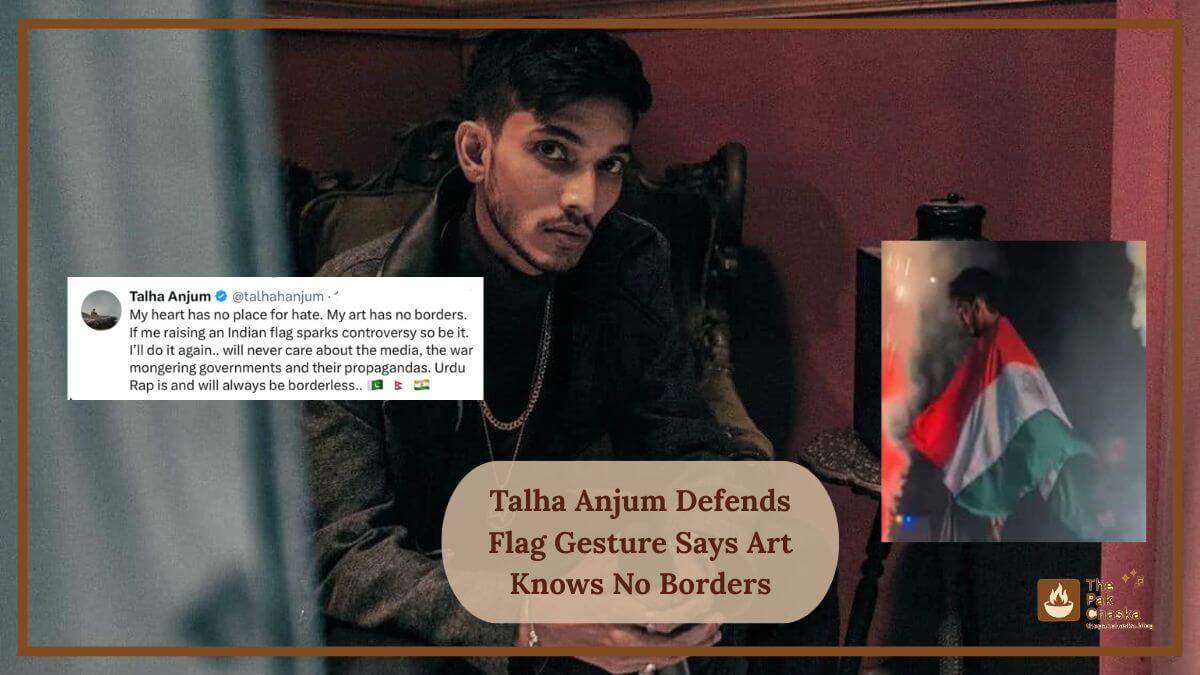
A lot of people were upset when Pakistani rapper Talha Anjum waved the Indian flag at a show in Nepal not long ago. People both liked and didn’t like the action, but Talha stood strong, explaining his choice and stressing that hate has no place in his heart. He said that Urdu rap goes beyond countries and that he would make the same choice again, showing how art can bring people together.
The Controversial Moment:
Talha Anjum held the Indian flag on stage during a live show in Nepal, which got a lot of attention on social media. Some people liked the move because they saw it as a sign of cultural unity and peace, while others thought it was inappropriate to fly a flag from another country in public. The event became popular very quickly and led to discussions about nationalism, art, and the duties of public people.
Talha reacted directly to the controversy and made it clear what he meant. “I don’t hate anyone, and art doesn’t have borders.” Urdu rap is popular all over the world, and he said, “I would raise the flag again.” His message supports the idea that art and music should bring people together, help them understand each other, and respect each other instead of dividing them.
Art Beyond Borders:
Talha’s argument shows a bigger picture of art as a force that goes beyond things. From his point of view, music doesn’t care about politics or country allegiances; it’s meant to bring people from different cultures together. People all over the world agree with this method because they see art as a universal language that can help people understand each other and talk to each other.
Even though it may be controversial, his action is in line with his goal of using music to spread messages of peace, unity, and acceptance. Talha says that to be a real artist, you have to be brave enough to stick to your beliefs, even if people don’t understand or agree with you.
Check Also: Simi Raheal Praises Todays Actors Says Every Era Has Beauty
Public Reactions:
People have had very different reactions. Many of Talha Anjum’s fans praised him for taking a strong stand and pointing out that art should question social rules and bring people together. They think the flag move is a sign that music and performances can bring people together.
Critics, on the other hand, say that national symbols should be treated with care because they have deep emotional meaning. Some people think that the action, no matter what the intention was, could be seen as rude or political. The argument shows how complicated it is for personal expression, cultural meaning, and how the public sees things.
Responsibility of Public Figures:
People should also be aware of the duties of public officials because of Talha Anjum’s story. People pay close attention to celebrities when their actions, even if they don’t mean to, involve politics or national identity. His action was meant to honor art and peace, but it shows how symbolic actions can be interpreted in different ways.
Talha’s answer shows how important it is to be open and talk to each other as a well-known person in the music business. By making his meaning clear, he was able to put the gesture in its proper context and help people understand, even though the arguments are still going on.
Conclusion:
Talha Anjum’s defense of flying the Indian flag in Nepal shows how difficult it is for artists to express themselves without worrying about how people will see them. Talha supports the idea that art can bring people together, push boundaries, and start conversations by saying that Urdu rap goes beyond borders and that he doesn’t harbor any hate.
What happened is a good reminder that meaning and context are just as important as symbols. The way Talha Anjum stands up for art encourages both artists and audiences to see how it can connect people from different backgrounds. He wants culture and creativity to bring people together instead of dividing them.
Frequently Asked Questions:
-
What did Talha Anjum do during his Nepal concert?
He waved the Indian flag on stage and said it was a sign of togetherness and peace.
-
Why did he wave the Indian flag?
Talha said that hate has no place in his heart and that Urdu rap goes beyond countries, showing that art is for everyone.
-
How did he respond to the controversy?
He defended the action by saying he would do it again and that it showed his belief in art without borders.